EPFL’s home-grown programming language Scala has won this year’s Programming Languages Software Award. The honor is awarded by ACM SIGPLAN each year to an individual or an institution to recognize the development of a software system that has had a significant impact on programming language research, implementations, and tools. Scala was originally developed by Professor Martin Odersky in 2004 at the School of Computer and Communication Sciences (IC). Professor Odersky now heads the Scala Center, an open-source foundation for the software based at EPFL.
Read MoreNews
EcoCloud Research Wins Runner-up Paper Award at SpringSim’19
The 2019 Spring Simulation Conference (SpringSim’19) concluded on May 2 at Tucson, Arizona. During the four-day event, many original papers were presented on the theory and practice of modeling and simulation in the scientific and engineering fields. The conference was especially significant for EPFL and EcoCloud because a paper co-authored by PhD scholar Yasir Mahmood Qureshi was selected for the Runner-up Paper Award.
Read MoreVulnerabilities in Machine Learning
Media coverage on the distant future of AI and machine learning have painted a scary picture of machines going berserk, rampaging killer robots, and rogue self-driving cars. Those ugly manifestations of machine learning are unlikely to go beyond fiction. But the dangers of machine learning can—and already have—taken different routes. A couple of podcasts featuring El Mahdi El Mhamdi, PhD scholar at EPFL, shed important light on the dark side of AI—poisoned data sets, bad actors, AI-generated fake news, and the Byzantine problem—and his work on technical AI safety and robustness in biological systems.
Read MoreElison Matioli Joins EcoCloud
Elison Matioli, assistant professor at EPFL’s Institute of Electrical Engineering and director of the POWERlab, has joined EcoCloud.
Read MoreRPCValet features on The Morning Paper
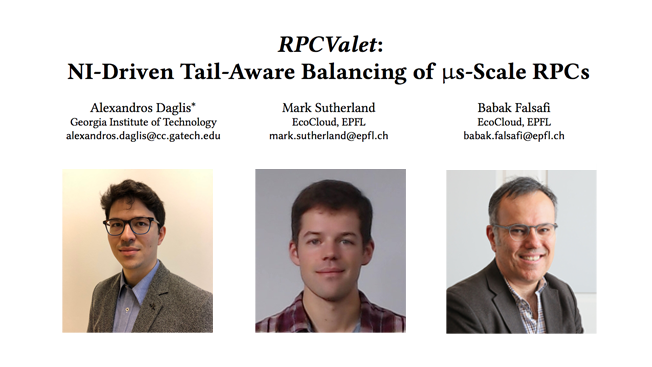
Every weekday, avid followers of computer science wake up to a new writeup by the inimitable Adrian Colyer on his blog The Morning Paper. His insightful selections help bring practical ideas from the academia to the computing practitioner. In a year, readers are exposed to concepts and ideas from more than 200 papers. In his latest post, Adrian Colyer presents a paper co-authored by Alexandros Daglis, Mark Sutherland, and EcoCloud Founder-Director Babak Falsafi.
Read MoreEPFL Students Win European QIF Program 2019
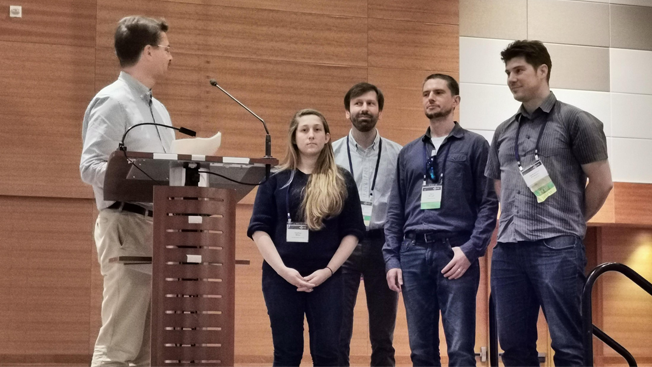
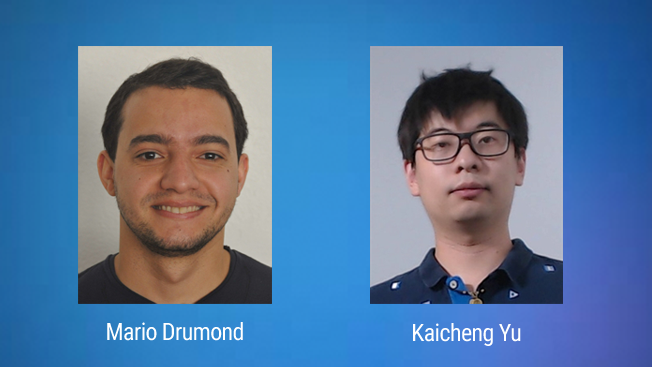
Qualcomm Technologies has just announced four winners of the Qualcomm Innovation Fellowship (QIF) for 2019. Among them are Mario Paulo Drumond and Kaicheng Yu, students at EPFL’s School of Computer and Communication Sciences (EDIC). They have been recognized by Qualcomm for their outstanding research proposals on emerging technologies.
Read MoreVolkan Cevher Wins Google Faculty Research Award
Google AI has announced the list of winners for its Faculty Research Awards (2018), and among them is Professor Volkan Cevher from the LIONS’ lab at EPFL. He has earned the distinction under the category ‘Machine learning and data mining.” He is one of only two winners from Europe in that category.
Read MoreShore-MT: Created by EPFL, Used by the World
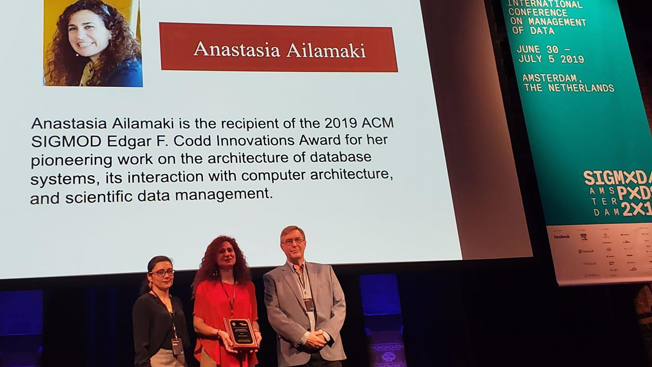
In 2009, EPFL professors Anastasia Ailamaki and Babak Falsafi collaborated with their doctoral and postdoctoral students to present Shore-MT, a scalable storage manager for the multicore era. A decade later, Shore-MT continues to be a robust open-source database storage manager preferred by many users worldwide. In recognition of its continued relevance and usage, the original research paper has been honored with the 2019 EDBT Test-of-Time Award.
Read MoreOpen Science Fund: Breaking Barriers for Open Research
The impact of scientific research findings remains limited unless they are disseminated among the research community as a whole. However, sharing research openly is not easy because of many cultural and technological barriers. In a bid to remove those impediments in the way of open research, EPFL President Martin Vetterli launched the Open Science Fund in September 2018.
Read MoreNew Research Leverages SMoTher, a Port-induced Side Channel
In a paper published earlier this month, a team of researchers from EPFL and IBM Research introduce the port-induced side channel called SMoTher. They show how it can be leveraged (instead of a cache-based side channel), as a powerful transient execution attack to leak secrets that may be held in registers or the closely-coupled L1 cache, called SMoTherSpectre.
Read More