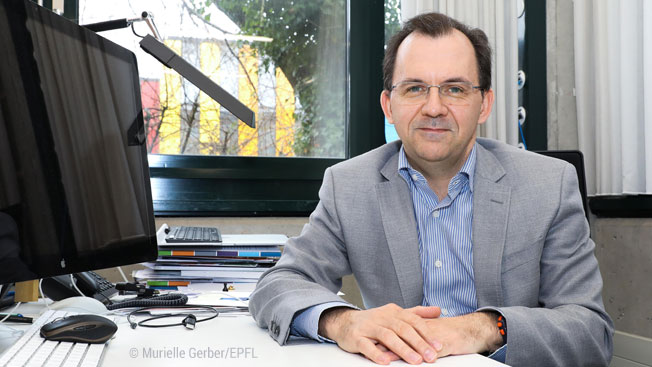
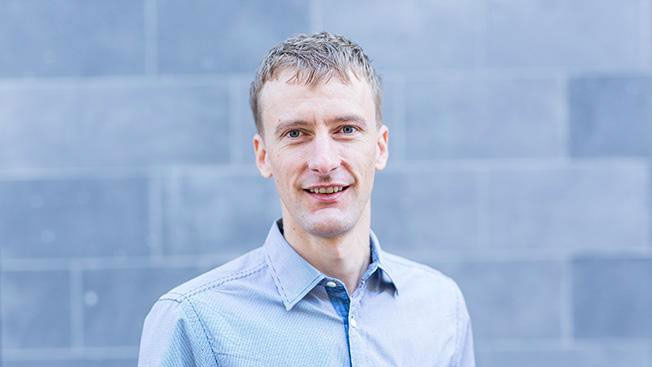
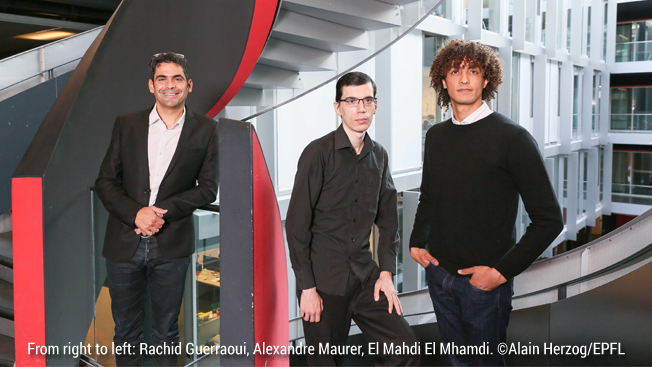
In March 2016, EPFL and the International Committee of the Red Cross (ICRC) signed a seminal agreement to establish the Humanitarian Tech Hub. The four-year program has opened many avenues of collaboration between the scientific and humanitarian fields. To further cement that relationship, ICRC has just announced the appointment of EPFL’s Edouard Bugnion to the ICRC Assembly.
Read MoreNews
Polisis: An AI Eye to Decipher Privacy Policies in Seconds
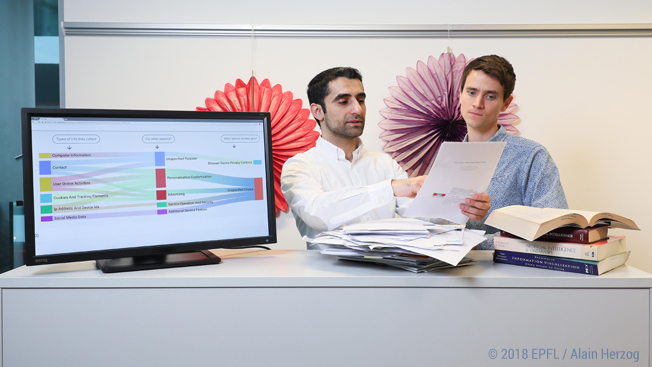
Web browsing has become almost second nature to us. Each day, we plunge into tens of websites and unwittingly accept their long-winded privacy policies without bothering to peruse their stipulations. This is undoubtedly because those documents are shrouded in legalese too dense and cumbersome to read and digest. Yet, it is a well-known fact that many websites collect, store, and even use the private data that we inadvertently leave behind during our browsing sessions. Disturbingly, such practices are usually protected by the legal jargon contained in their privacy policies. So how do we ascertain the nature of data collected by a website? Is it possible to know how our data will be used by a website even before we start browsing that site?
Read MoreBuilding Efficient Causal Consistency Systems: A LABOS-LPD Joint Initiative Funded by EcoCloud
Geo-replication is gaining ground for distributed services because it brings the services closer to the end users, reduces the page-load time, and increases user engagement. It also enables data platforms, such as that of Facebook, to survive data center failures. However, recent work has proven that no distributed data system can assure the best of desirable properties like low-latency access, partition tolerance, and strong consistency.
Read MoreScientists Develop 10X Faster Machine Learning Algorithm
Training of large-scale machine-learning models is extremely challenging because the training data is much more than the memory capacity. However, scientists at IBM and EPFL have collaborated to develop a novel scheme that enables the use of accelerators such as GPUs and FPGAs to speed up the training of machine learning models. They presented their findings at the 31st Annual Conference on Neural Information Processing Systems (NIPS) in Long Beach, California.
Read MoreDynamic Safe Interruptibility: A Breakthrough in AI
Machine learning and artificial intelligence (AI) are finding new applications across industries. Many tasks that were performed by humans are now being handled by machines, adding efficiency to the output. But what would happen if AI crosses the threshold of human control and makes unilateral decisions? It is a frightening, but highly probable, scenario. In 2014, it prompted Google to consider the idea of a “big red button” to stop dangerous AI in an emergency. However, the challenge is not in being able to stop or interrupt an AI process but in preventing AI from biased learning due to such frequent interruptions. The biased learning can be extremely dangerous in multi-agent systems, where several machines are involved in an AI task.
Read MoreEd Bugnion Talks about Cloud Computing on Swiss TV and Radio Station RTS
The program in French can be found here.
Read MoreAnastasia Ailamaki Elevated to IEEE Fellow
Anastasia Ailamaki, Professor and Lab Director at the Data-Intensive Applications and Systems Laboratory (School of Computer and Communication Sciences), has just added another feather to the cap of EPFL’s research excellence. IEEE has included her as IEEE Fellow in the Class of 2018.
Read MoreEdouard Bugnion Named ACM Fellow
The Association for Computing Machinery (ACM) has named EPFL Professor Edouard Bugnion as ACM Fellow for 2017. This is ACM’s most prestigious member grade where only the crème de la crème of the computing research fraternity find admittance.
Read MoreEPFL’s Bryan Ford to Provide New Impetus to Blockchain Research
The research will ultimately contribute to the next generation of financial services and likely even more innovative applications of the technology not only here in Switzerland but globally.
Read MoreACM Appoints David Atienza as “2017 Distinguished Member”
The digital revolution is now all-pervasive, charting breakthroughs in computing and information technology. Driving that change is a group of leading innovators across the world. Among them is David Atienza, associate professor of Electrical and Computer Engineering and director of the Embedded Systems Laboratory at the School of Engineering, EPFL. In recognition of his outstanding scientific contributions to computing, the Association for Computing Machinery (ACM) has acknowledged him as a “pioneering innovator” and a “2017 Distinguished Member.”
Read More