
EPFL is trying to maximize the use of computing infrastructure to end-of-life, contributing to global sustainability in the IT sector. As part of this strategy, the Helvetios cluster has been donated to the Universidad Nacional de Córdoba (UNC) in Argentina, to give it a “second life”.
Prof. Nicolas Wolovick of UNC has explained how important it is to maintain momentum in the field of computation, by upgrading facilities: “Without new hardware technical staff lose interest, scientists stop running computations, and a downward spiral begins. I’ve seen this story play out dozens of times across Latin America: HPC in fits and starts. A single investment, followed by a decade of computing degradation due to Moore’s Law.
“Helvetios is geared toward drug design, cosmological simulations, and engineering design, because its greatest strengths are its large number of nodes, vast memory capacity, and ability to perform high-precision computing,” Prof. Wolovick explains.
“This cluster represents a massive surge in computing power for UNC, in scale, storage, and networking capabilities. After just one day, the mindset of our technical team has shifted completely: they are witnessing a leap in scale of an entire order of magnitude.”
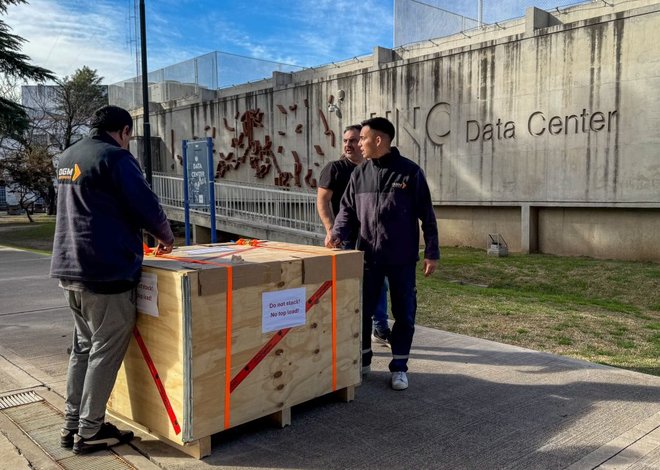
The shipment consists of nearly four tons of equipment. This includes 288 nodes, each equipped with two Xeon Gold 6140 processors. Each processor has 192 gigabytes of RAM.
Prof. Wolovick confirms that Helvetios made a successful voyage: “All the equipment arrived in excellent condition. The packaging worked perfectly, and there were no issues with the shipment by sea.”
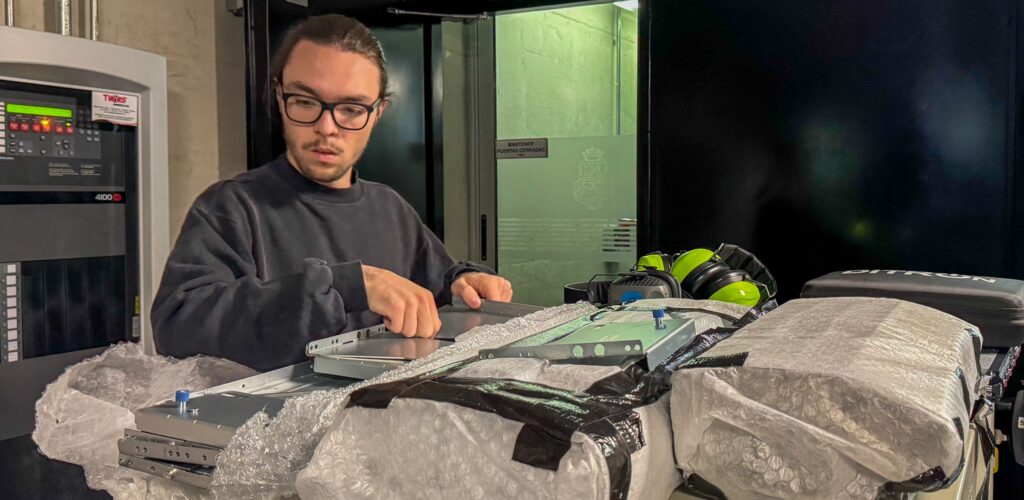
The system will be operational in a month, tripling the compute capacity of the Universidad Nacional de Córdoba.
Prof. David Atienza (Associate Vice-President for Centers and Platforms) is happy to announce that EPFL is meeting its goal of recycling hardware. “Disposing of this kind of hardware in the traditional way involves the landfill of massive metallic structures, but also toxic materials such as lead, mercury and cadmium. It is up to us, as an organization, to find a home for large installations that are no longer of use here, but which can boost the research capacity of another top research institution somewhere else.
“In this case we found a win-win strategy after Antonio Russo, currently at EPFL but formerly of UNC, discussed with the team of the EcoCloud Center of EPFL about the clear benefits of trying to donate Helvetios instead of just recycling. EcoCloud pointed out it was much better from a sustainability perspective to donate and try to extend the life to extend the life of the cluster in collaboration with the University of Córdoba, who will put it to good use and use it for years of research in Argentina.
“We hope to replicate this approach many times in the future, and to make sure the computing infrastructure of our new Integrated Computing Platform (ICP) at EPFL can be used for as long as possible, to minimize the impact of computing production on the planet.”
News item from Canal 10 Córdoba, Argentina:
UNC article (in Spanish):
La UNC suma más poder de cómputo, gracias a una donación desde Suiza
Photos: UNC