There are thousands of courses on offer at EPFL, covering topics as far apart as socio-environmental learning, epilepsy monitoring and urban digital twins. We decided to have a closer look at a very special course, one which brings together the three fundamental principles of EPFL Institutes: education, research and industry.
Field Programmable Gate Arrays (FPGAs) are a unique technology. Some chipsets are compared to Swiss Army knives, being equipped with many "blades". FPGAs are not multi-blade. Try to imagine a single blade that can change its shape on demand: corkscrew, can-opener, the thing for removing stones from horses' hooves - this "blade" can be instructed to take any of these forms.
The logic gates of FPGAs rearrange themselves according to the demands of the engineer, which means that one chip can be requested to perform many tasks at once, or to perform a single set of tasks concurrently, as if there were many chips being used in parallel. This can result in astonishing gains in processing speed and energy - but it is highly complex.
Alejandro López Rodríguez took the course in HW-SW digital systems codesign (EE390a) from 2023 to 2024, in the first year of his Master's degree: "I had previously had access to limited versions of FPGA-type devices, but in this lab we got to use fully dedicated operational FPGAs. We optimized our design to instantiate a whole bunch of workers, and we achieved a really fast processing time."
Industry partner AMD Xilinx had donated a number of FPGAs to EPFL for this purpose. The task in this instance was to perform genomic sequence alignment, with optimal speed and low power consumption.
"We even went to the trouble of deactivating LEDs on the board to save energy, adapting it so we could run the platform on a single Watt," enthused Alejandro. "It was a massive challenge, also because we had to learn how to work in pairs. Hardware ideas form in your head: it is difficult to collaborate on practical tasks like that, but we worked it out.
"When we had discussed with Miguel how we were planning to go about it, we could see he was smiling, so we knew we were on the right track!"
Dr. Miguel Peón Quirós of the EPFL EcoCloud Center is a post-doctoral alumnus of Prof. David Atienza's Embedded Systems Lab (ESL), the main host of this course.
"This was a very strong project," explains Miguel. "Their solution was very scalable: with a doubly powerful FPGA they could have halved their time."
After completing the course in 2024, Alejandro helped to design the new hardware for energy measurement for use in the following year's course. He is now doing a Master internship in IMEC, Leuven (Belgium), and will continue with his Master Thesis in ESL and in collaboration with MIT, Cambridge (USA).
The Lab on HW-SW digital systems codesign introduces students to the design of fast and energy-efficient computing systems with FPGAs. Beyond technical expertise, a key aim of the course is to foster soft skills such as sustainability, teamwork, project planning, and the ability to decompose complex problems. This aligns with recent research from EPFL’s LEARN Center that uncovers the lack of protagonism of these skills in bachelor courses.
For the year 2024 to 2025, Dr. Denisa Constantinescu and doctoral assistants Rubén Rodríguez Álvarez and Stasa Kostic, all from ESL, explored possibilities for an enticing new challenge.
Although Denisa is a member of the Embedded Systems Lab and collaborator of SKACH (Square Kilometer Array Switzerland), her passion for data optimization and for space science means she also works in close collaboration with EcoCloud, eSpace, the Laboratory of Astrophysics (LASTRO) and Callista.
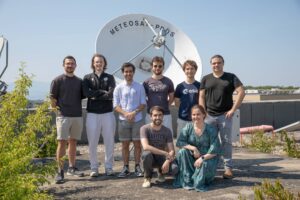
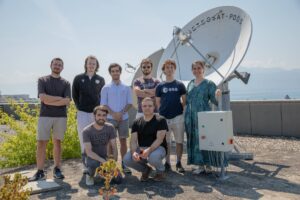
Callista is a student-run association that aims to promote interest in astronomy and astrophysics among students at EPFL and UNIL. Among other assets they have a telescope called VEGA, which resides on the roof of the Institute of Electricity building, ELA1. The idea arose that students could use FPGAs to optimize the processing of data received from VEGA. Data streamed from the telescope is segmented in batches of ten seconds. Their goal is to process faster than those ten seconds to get as close to real time as possible.
A high-level task, using complex technology, in a limited time frame - not easy.
"In the beginning, most students don't ask the right questions, especially about debugging. And sometimes they don't set a clear goal," explains Rubén.
"We give them a lot of feedback at the start of the project: to define the objectives, the steps, the milestones," adds Denisa. "This is all part of working together on complex projects."
"In the past," explains Miguel, "students had full freedom to decide their project, but many would end up saying ‘We should not have been so ambitious!’ So, Rubén suggested that we provide a framework, ten configurations for accuracy and load, from which the students could pick and choose a certain number. Even then, some students immediately declared that they would tackle all ten!"
Three students who took part in this course were Leonardo Vega, Eliot Abramo and Matthias Rainaldi.
These go up to eleven
"It was an exciting project," explains Leonardo, "We could optimize a lot of tasks to make them faster, more efficient, more precise."
"It does take a lot of time to learn how to program FPGAs," adds Eliot, "but once you get used to it, things go faster, and then it's just amazing... There is such an advantage to being able to perform lots of tasks in parallel, and you can really do cycle by cycle optimizations."
"As the data comes in," explains Matthias, "you're processing another load of data in parallel, and you can do that continuously. So the board is doing multiple things at a time."
We asked all three to rate FPGA technology in terms of difficulty, on a scale of 1 to 10, compared to everything else they had studied thus far. Their answer was unanimous:
"Eleven."
Eliot will be working for a year at SpaceLocker (France), before joining the other two in Master programs at EPFL.
"It is quite rare for projects - in particular Bachelor projects - to have any kind of real-world application," explains Aurélien Verdier, a doctoral assistant in the Laboratory of Astrophysics, who was advising on the preparation of the project. "In this case it really did have a concrete result: a very cool improvement for pedagogical hardware on the campus."
Léonard Lebrun, a master student in the Section of Physics, also had an advisory role on the project preparation, and as a member of Callista, was grateful for this collaboration: "This work was actually filling a gap in the needs of our association, which has been developing the telescope for two years now. Our aim is not to beat the massive laboratories to great discoveries, but to show that we can do some of what they do, with a fraction of the means.
"The entire device has a pedagogical objective, so if these students can accelerate our data retrieval, while at the same time developing their own skills with FPGAs, it is great for our organization, and great for them."
Flexibility is a theme that runs all the way through this course, from the FPGAs themselves to the multitalented students taking part.
It should therefore come as no surprise that the Embedded Systems Lab alone is currently carrying out research projects on areas as diverse as socio-environmental learning, epilepsy monitoring, and urban digital twins - the three diverse subjects mentioned in the first paragraph. Despite their variety, these projects share a unifying focus: energy efficiency.
This kind of disruptive laboratory challenges students to step outside their comfort zones and engage with real-world project experiences. Denisa explains, “More undergraduate courses should aim to bridge the gap in soft skills like teamwork, planning, and tackling open-ended problems. These courses are demanding—for both students and instructors—but they’re incredibly rewarding. At the final presentation, many students said, ‘This is the course where I learned the most.’ That’s why I believe it’s worth the effort.”
Original article by John Maxwell